Installing the game on your phone: what actually works
You've opened the site on your phone, tapped the menu, and now you're staring at three install options: «Add to Home Screen», «Download App», and something about an APK file. One of them will work. One might be overkill. One could be a mistake.
This is how most people find Chicken Road 2 on mobile in the United Kingdom: through a UKGC-licensed operator's site, usually in the browser, sometimes wrapped as a progressive web app. A small number download the operator's native app from Google Play or the App Store. APKs exist, but they come with risks that aren't worth it unless you know exactly what you're installing and why.
Store-style card: what the listing would say
If Chicken Road 2 had its own app-store page—and most crash games don't, because they live inside operator apps or as web apps—the listing would look something like this. These numbers are consistent with what you'd see for a mid-tier crash game on the UK market in 2026.
The 18+ rating isn't negotiable. You'll need to verify your age and identity before you can deposit—most UKGC sites use credit-reference checks at signup, then ask for documents before your first withdrawal. That process takes 24–48 hours, sometimes longer if the scan is blurry or the name doesn't match your payment method.
What you see when you open it
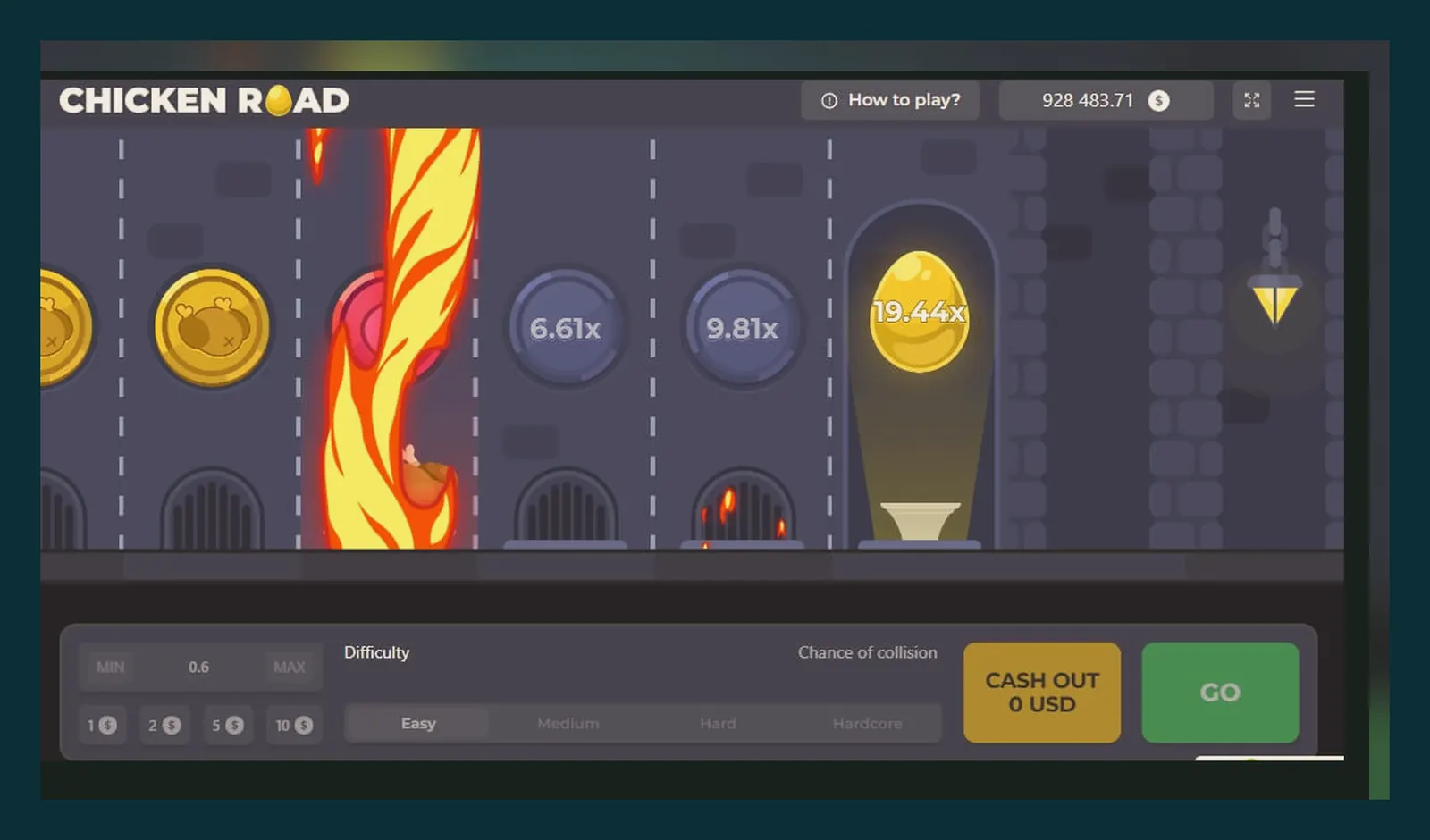
The game opens to a 5×4 grid with a chicken avatar at the bottom-left. The main screen shows your balance in the top-right corner, formatted as £10.00 or whatever you've deposited, and a stake selector below it. Tap the grid tiles to reveal your path; each safe tile lights up green, each bomb ends the round and shows a red explosion sprite.
The second screen is the bet slip. You pick your stake—capped at £5.00 per round if you're over 25, £2.00 if you're 18–24—and decide whether to cash out after each tile or keep going. A multiplier ladder runs down the right edge, showing what you'd win if you stopped now. The ladder updates in real time as you click.
The third screen is your bet history. Every round logs the stake, the multiplier you reached, whether you cashed out or hit a bomb, and the timestamp. Tap any row to see the tile sequence. This is useful for tracking your session, but it won't tell you where the next bomb is—each round is independent, seeded by the RNG, and verifiable if the operator publishes hashes.
The fourth screen is settings: sound toggle, animation speed, balance display (show or hide), and a link to your account page. That account page sits outside the game, on the operator's main site, where you'll find deposit limits, GAMSTOP self-exclusion, transaction history, and the KYC upload form. The game itself is just the front end; everything else is handled by the casino platform.
A fifth optional screen is the leaderboard or live-bets feed, if the operator includes one. You'll see recent big wins—anonymised usernames, multipliers, and stakes—but these are promotional. They show the ceiling, not the median. Most rounds end before 2× or 3×, and the feed doesn't show the losing streaks.
Four ways to install it, step by step
The safest and most common route is the browser. You don't install anything; you just bookmark the operator's site and open it in Chrome or Safari whenever you want to play. The game runs as HTML5, loads in a few seconds on 4G or WiFi, and saves your session in cookies. No app permissions, no extra storage, no update nagging. The downside: if you clear your browser data, you'll need to log in again, and some operators gate demo play behind a login even though you're age-verified.
- Open the operator's site in your mobile browser (Chrome, Safari, Firefox).
- Log in or register—you'll need to verify your age and identity before you can deposit.
- Navigate to the game: usually under «Crash», «Instant Win», or a search for Chicken Road 2.
- Tap «Play Now». The game opens in the same browser tab or a new one, depending on the site.
- Bookmark the page (three dots → «Add to bookmarks») so you don't have to search again.
The second option is «Add to Home Screen», which turns the web app into a shortcut with an icon. It's still a browser under the hood, but it opens in full-screen mode without the address bar. On iOS, open the site in Safari, tap the Share icon, then «Add to Home Screen». On Android, open the site in Chrome, tap the three dots, then «Add to Home Screen». The icon appears next to your other apps, but it's not a native app—it's a progressive web app, or PWA. The advantage: one tap to launch. The risk: minimal, because it's still the same UKGC-licensed site, just with a launcher.
The third option is downloading the operator's native app from Google Play or the App Store. Some UKGC-licensed operators—not all—publish their own casino apps, and Chicken Road 2 will be inside if the operator carries it. Search for the operator's name (not the game's name), check the developer matches the official site, then install. The app is larger—60 to 120 MB—and asks for permissions: notifications (so they can ping you about bonuses), storage (to cache game assets), and sometimes location (to confirm you're in the UK). The app won't let you play if you're abroad, because the UKGC licence restricts remote play to UK territory.
- Open Google Play (Android) or the App Store (iOS).
- Search for the operator's official app—check the developer name matches the footer on their website.
- Install the app and open it. You'll be asked to log in or register.
- Grant permissions if prompted: notifications are optional, storage and location are usually required.
- Find Chicken Road 2 in the game lobby—search or filter by «Crash» or «Instant».
- Tap to launch. The game runs inside the app, with your balance and account shared across all games.
The fourth option is an APK file, which is an Android app package you download directly instead of through Google Play. This is where the risk jumps. APKs can be legitimate—some operators offer them for regions where Google Play is restricted—but they can also be repackaged clones that steal login credentials, inject ads, or bypass stake caps and affordability checks. If you're in the United Kingdom, there's no reason to use an APK: UKGC-licensed operators are in Google Play and the App Store, or they run perfectly well in the browser. If you do download an APK, check the file size (should match the official app, around 60–120 MB), verify the SHA-256 hash if the operator publishes one, and never grant permissions for SMS, contacts, or phone calls—those are red flags.
What your phone needs to run it
Chicken Road 2 is light. If your phone can browse the web without lag, it can run the game. The browser version needs Chrome 90+, Safari 14+, or Firefox 88+ on mobile. Android 8.0 (Oreo) or iOS 13 is the practical floor—older versions might work, but the operator's site won't be optimised for them, and you'll see layout bugs or missing buttons.
RAM: 2 GB minimum, 3 GB comfortable. The game itself uses about 50–80 MB of memory, but the browser or operator app adds overhead. If you're running other apps in the background—music, maps, messaging—you might see stutters or forced reloads on a 2 GB device. Storage: 50 MB free for the browser cache, 100–150 MB if you're installing the operator's app. Screen: any size works, but the game is easier to play on a 5-inch display or larger; the grid tiles are small on a 4.5-inch screen.
Network: 3G will load the game, but you'll notice a delay between tapping a tile and seeing the result. 4G or WiFi is recommended. The game sends and receives tiny packets—your bet, the server's reveal, the new balance—but if the connection drops mid-round, the round completes on the server side and the result appears when you reconnect. You won't lose a winning round to a dropped connection, but you also can't cancel a bet once it's placed, even if your screen freezes.
Battery: expect about 3–4 hours of continuous play on a 3,000 mAh battery at 50% brightness. The game isn't demanding, but the screen is on, the network is active, and the operator's app might run background tasks (sync, notifications). If you're playing on the bus or in a café, keep a charger handy.
What the app does beyond the game
If you're using the operator's native app, it's not just a game launcher—it's the entire casino platform squeezed into a mobile interface. You can deposit, withdraw, set limits, upload ID documents, contact support, and browse hundreds of other games. The app syncs your balance and session across devices: start a round on your phone, close the app, open the website on your laptop, and the game state persists because it lives on the operator's server, not locally.
The app will ping you with notifications—new bonuses, free-bet offers, reminders to complete KYC—and some of these are mandatory under UKGC rules. If you hit £150 in net deposits over a calendar month, the operator must run an affordability check using credit-reference data. You'll get a notification asking for payslips or bank statements if the automated check flags a risk. This isn't the app being nosy; it's the licence requirement. You can turn off promotional notifications in settings, but regulatory ones will still appear.
The app also enforces stake caps. If you're 18–24, the app knows your age from the KYC check, and it won't let you bet more than £2.00 per round. If you're 25 or older, the cap is £5.00. These limits are hard-coded and can't be overridden, even by customer support. The same goes for deposit limits: you can lower yours anytime, but raising it triggers a 24-hour cooling-off period. If you've self-excluded via GAMSTOP, the app checks the register at login and blocks access for the exclusion term—6 months to 5 years.
What changed in the latest version
Version 2.1.4, released in January 2026, made three changes players actually notice. First, the bet-slip UI was rearranged: the cash-out button moved to the bottom centre, larger and harder to miss, after complaints that people were accidentally clicking through to the next tile when they meant to stop. Second, the settings screen added a «Session Timer» that shows how long you've been playing and pops a reminder every 60 minutes. It's not mandatory, but it's on by default, and you have to dig into settings to turn it off. Third, the game now displays your total profit or loss for the session in the top-left corner, updated after every round. It's a small addition, but it makes the maths harder to ignore.
Under the hood, the update improved load times on slower connections—the game preloads tile assets while you're on the lobby screen—and fixed a bug where the multiplier ladder would briefly show the wrong value if you clicked two tiles in quick succession. The operator's release notes also mention «enhanced RNG verification», which likely means the server now logs the seed hash for every round, not just on request. If your operator publishes provably fair tools, you can check the hash yourself, but most players don't bother unless they suspect something off.
What didn't change: the RTP, the grid size, the multiplier curve, or the bomb placement algorithm. Those are baked into the game's mathematics and don't shift with updates. If an update ever claimed to «improve your chances» or «reduce losses», that would be a red flag—it's either marketing nonsense or a sign the game was rigged before and fixed now, neither of which is reassuring.
How to spot a fake clone and which permissions are a red flag
Fake clones are common, especially for popular crash games. They copy the look—same grid, same chicken sprite, same colour scheme—but the back end is different. Some are scams: you deposit, you play, you «win», and the withdrawal never arrives. Some are unlicensed operators skirting the UKGC by claiming to be offshore, which is illegal to advertise to UK players. Some are repackaged APKs with injected ad libraries or keyloggers. The common thread: they're not listed in the UKGC register, and the licence number in the footer is either missing, fake, or belongs to a different operator.
Here's how to check. First, search the operator's name in the UKGC public register (on the Commission's website). Match the licence number in the register to the one in the site footer. If they don't match, or if there's no footer licence at all, stop. Second, check the domain: UKGC-licensed operators use .co.uk, .com, or .uk domains, and the domain is listed in the register entry. If the site is on a .xyz, .cc, or .to domain, it's almost certainly unlicensed. Third, look at payment methods: UKGC sites offer debit cards, PayPal, Trustly, Apple Pay, and paysafecard. They do not accept credit cards—banned since 2020—and they do not ask for crypto. If the site wants Bitcoin or a credit card, walk away.
If you're installing an app, check permissions before you open it. A legitimate casino app needs: storage (to cache game files), network access (to connect to the server), and optionally location (to verify you're in the UK) and notifications (for bonuses and regulatory messages). A casino app does not need: SMS (to read or send texts), contacts (to access your address book), phone (to make calls), camera (unless you're uploading ID), or microphone (ever). If an app asks for SMS, contacts, or phone permissions, it's either a clone that's harvesting data or a badly coded app that's asking for blanket permissions it doesn't use. Either way, don't install it.
| Permission | Legitimate casino app | Red flag |
|---|---|---|
| Storage | Yes – cache and game assets | No – if asking for «full storage access» beyond app folder |
| Network | Yes – server connection | No – never a red flag |
| Location | Sometimes – UKGC geo-check | No – only if mandatory and explained |
| Notifications | Yes – bonuses and regulatory alerts | No – can be declined |
| Camera | Sometimes – ID upload | Yes – if requested before KYC step |
| SMS / Contacts / Phone | No – never needed | Yes – always a red flag |
A final tell: clones often skip the KYC step or make it optional. A real UKGC site will block deposits until you verify your age and identity. If you can deposit £50.00 without uploading a document or answering a security question, the site isn't licensed. It might let you play, and it might even let you win, but when you try to withdraw, you'll hit a wall—either the payment never processes, or the site disappears, or support stops replying. That's the business model. By the time you realise, your money is gone.
Why some players stick to the browser
A lot of regular players never install the app. They open the operator's site in Chrome, bookmark it, and play from there. The reasons aren't about storage or updates—they're about control. The browser doesn't ping you with notifications unless you allow them, and you can block them site-by-site in your phone's settings. The browser doesn't ask for location permissions unless you're mid-transaction and the operator's payment processor requires it. The browser doesn't leave a dedicated app icon on your home screen where anyone who picks up your phone can see it.
The trade-off is convenience. The browser version loads fast, but it's not instant the way an app is. If you've got a dozen tabs open or your phone's low on memory, the game tab might reload when you switch back to it, which means logging in again. The app stays resident, so switching back is seamless. The app also caches more aggressively, so subsequent launches are faster, and you can enable Face ID or fingerprint login instead of typing your password every time.
For players who treat this as entertainment they dip into occasionally—once a week, maybe less—the browser makes more sense. For players who log multiple sessions a day, the app saves friction. Neither option changes the mathematics of the game. The RTP is the same, the RNG is the same, the affordability checks and stake caps are the same. The only difference is how quickly you can get from «I want to play» to the first tile reveal.
FAQ
Can I play Chicken Road 2 without installing anything?
Yes. Most UKGC-licensed operators run the game as an HTML5 web app, which means it loads in your mobile browser—Chrome, Safari, Firefox—without installing an app. Bookmark the page and you're done. The browser version has the same features as the app: same RTP, same RNG, same stake caps. The only difference is you won't get push notifications, and if you clear your browser data, you'll need to log in again.
Is the APK version safe to use in the UK?
Not recommended. UKGC-licensed operators are available in Google Play and the App Store, or they run perfectly well in the browser. If you're downloading an APK, you're either sidestepping the official channels—which means no automatic updates and no Play Protect scanning—or you're installing a repackaged clone. APKs from unknown sources can inject ads, log keystrokes, or steal login credentials. If an APK asks for SMS, contacts, or phone permissions, delete it immediately. Stick to the operator's official site or app unless you have a specific, informed reason to do otherwise.
Why does the app ask for location permissions?
UKGC-licensed operators are only allowed to serve players physically located in the United Kingdom. The app checks your location at login to confirm you're not abroad. If you decline location permissions, the app will either block access or ask you to verify manually (e.g., by entering your postcode and matching it to your registered address). Some operators only check location when you deposit or play, not at every login. The permission is legitimate, but if an app asks for location and you're installing from an unofficial source, that's a red flag—it might be tracking you for other reasons.
How do I know if the app is the real one or a clone?
Check the developer name in Google Play or the App Store: it should match the operator's official name, which you can verify on their website footer and in the UKGC public register. Compare the app size (60–120 MB is normal for a casino app; anything under 10 MB or over 200 MB is suspicious). Read the permissions: storage, network, and optionally location are fine; SMS, contacts, phone, or camera (before KYC) are red flags. Finally, check the reviews: if multiple recent reviews mention withdrawal problems, missing funds, or requests for crypto payments, it's either a clone or an unlicensed operator. The real app will have the UKGC licence number in the footer or About section.
What happens if I clear my phone's cache or uninstall the app?
Your balance, bet history, and account settings are stored on the operator's server, not locally on your phone. If you clear the cache or uninstall the app, you'll need to log in again, but your funds and session data are safe. The only thing you lose is cached game assets, which means the first launch after reinstalling will take a few extra seconds to load. If you're using the browser version, clearing cookies will log you out, but your account remains intact—just log back in with your credentials. Your deposit limits, KYC status, and GAMSTOP exclusion (if any) are tied to your account, not the app or browser, so those settings persist across devices.